
Can my home support an EV charger?
 Illustrative scene.
What we check
Your electricity supply
Most homes in Rwanda have a single-phase connection; some larger properties have three-phase. A wall-mounted AC charger draws a steady load for several hours, so the question is whether your connection has enough spare capacity alongside everything else in the house, especially in the evening.
Single-phase supplies suit single-phase chargers. Three-phase supplies open up higher-power options, but only if the vehicle’s onboard charger can use them. Prepaid meters work with home charging; what matters is the capacity behind the meter, which the assessment checks.
Your meter and distribution board
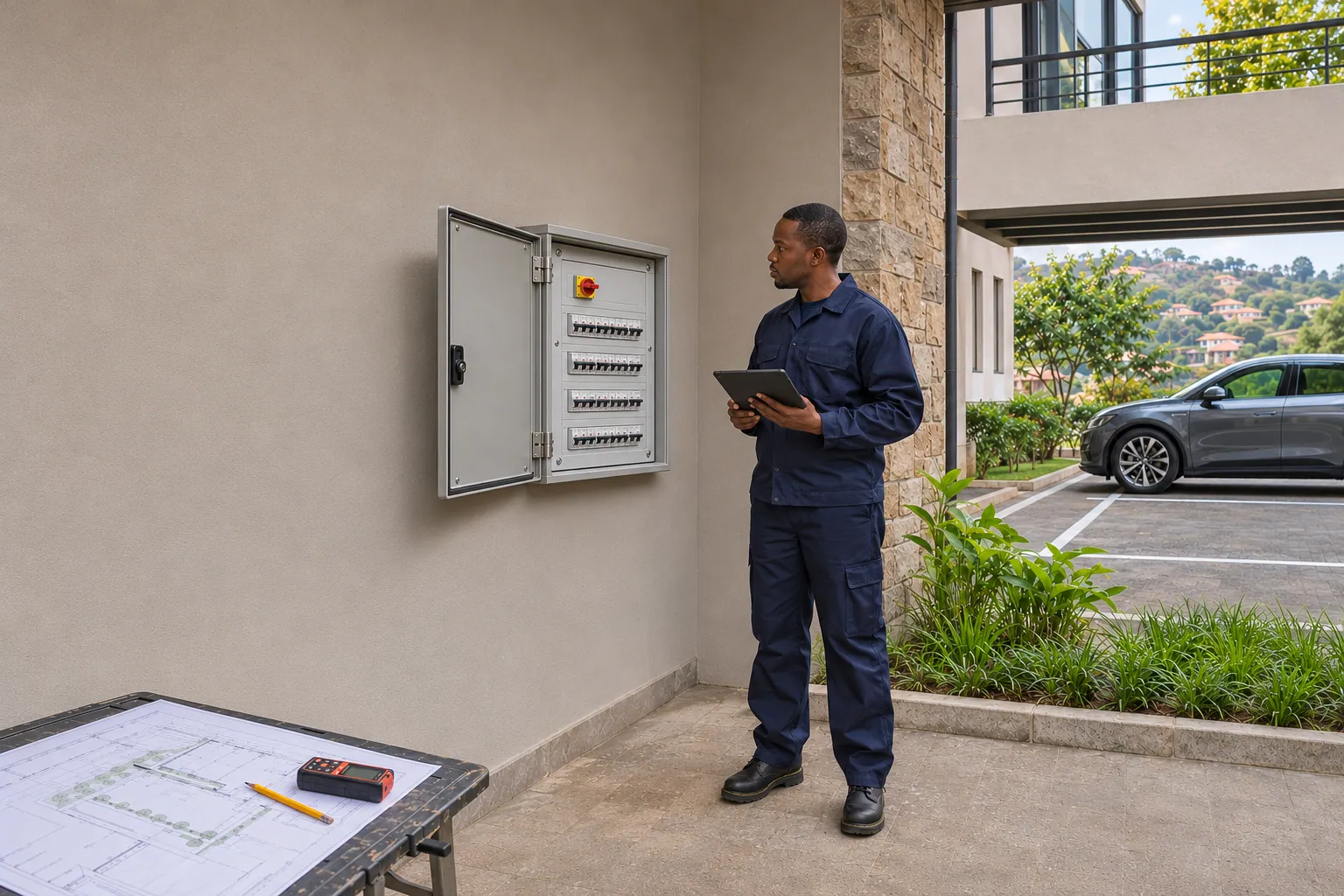
A charger needs its own circuit from the distribution board, with protection sized for the charger. Many boards have room for this; some older or fully occupied boards need a small upgrade first. We look at the board, the earthing arrangement and the condition of the existing installation before recommending anything.
If an upgrade is needed, it is described and priced in your quotation, so there are no surprises on installation day.
Where you park
The charger should sit close to the vehicle’s charging port with the cable reaching comfortably without crossing walkways. A garage or covered parking is ideal; a driveway or compound works with a weather-rated charger. Shared or street parking is harder, and we will tell you honestly whether it is practical.
Cable route and distance from the board affect cost, which is why we measure on site rather than guess.
Your vehicle
Two things about the vehicle matter: the connector type (many recent imports use Type 2 for AC charging, but not all) and the onboard charger’s limit. A vehicle that accepts 7.4 kW gains nothing from a 22 kW charger. We match the charger to the vehicle you have, and tell you what to consider if you expect to change it.
If the supply is not enough
A home that cannot support a full-power charger usually still has options: a lower-power charger that fits the available capacity, a charger with load management that adjusts to the rest of the house, or a supply upgrade through the utility. Each has a different cost and timeline, and your quotation sets out which applies.
What the assessment gives you
A clear answer about whether and how your home can charge your vehicle, a recommendation for suitable equipment, and a written quotation that sets out the installation and support arrangements that apply. Submitting a request does not confirm an appointment: we confirm service availability, any assessment fee and a time before a visit is arranged.